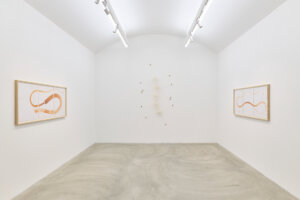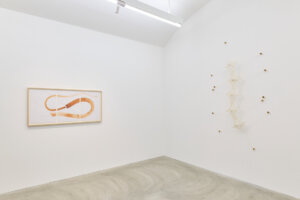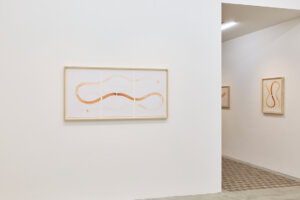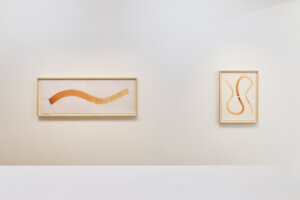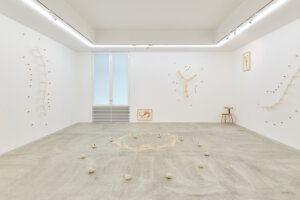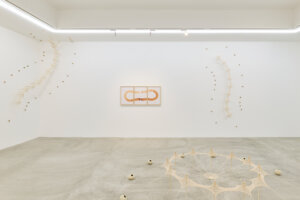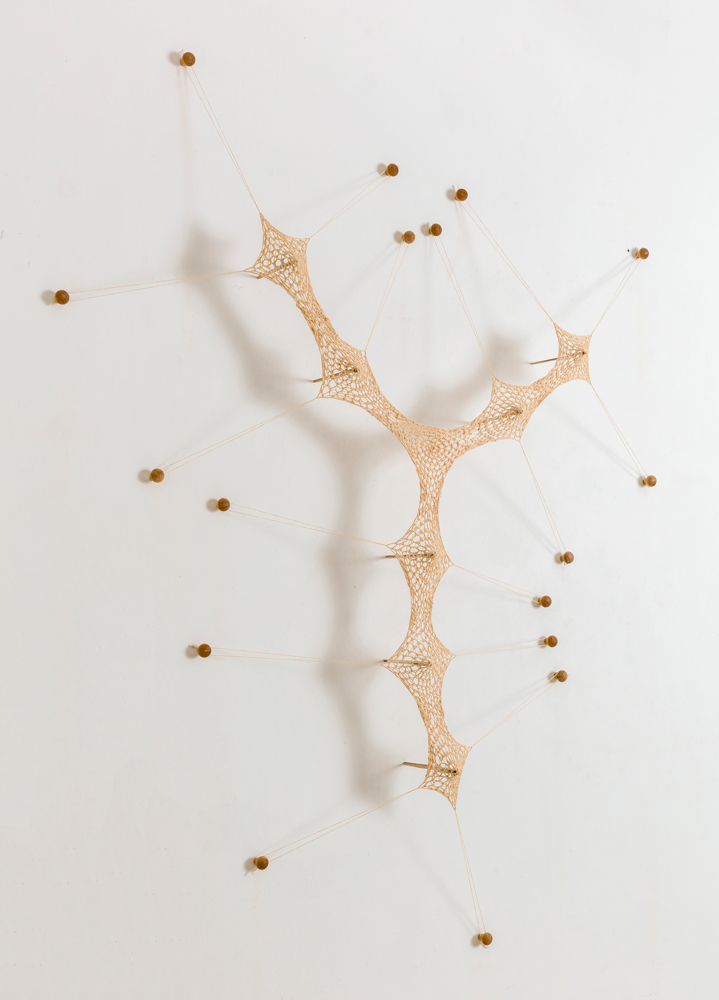
Tomio Koyama Gallery Roppongi is pleased to present “Dreaming Beings,” a solo exhibition by Ernesto Neto. This exhibition marks his first solo show at our gallery in 20 years and will feature a new series of three-dimensional works alongside a selection of drawings.
【Online Viewing】
Matterport by wonderstock_photo
【About Ernesto Neto and His Work】
Ernesto Neto is one of the leading contemporary artists from Brazil and is highly regarded internationally. Born in Rio de Janeiro in 1964, he continues to live and work in his hometown.
Since the late 1980s, he has presented soft sculptures made of stockings filled with Styrofoam balls and spices, but gradually shifted toward large-scale installations. In the 1990s, he began creating immersive installations using thin, highly elastic fabrics, featuring organic forms reminiscent of skin and internal organs. He also developed the “Nave” (Portuguese for “spaceship”) series, in which viewers could enter fabric structures suspended from the ceiling, tailored to the characteristics of the exhibition space, garnering attention from around the world.
Neto’s work carries on the legacy of Neo-Concretism, a movement that flourished in Brazil during the 1950s and 1960s that sought to encourage viewer participation and create new spaces for artistic expression. His works might be described as flexible installations that prompt viewers to reexamine their own physicality and existence, and even to produce a certain palpable connection to the universe and others by integrating various sensations that encompass not only sight, but also smell and touch.
Major solo exhibitions include the Guggenheim Museum Bilbao (2014), an installation at Zurich Main Station organized by the Beyeler Foundation (2018), the Pinacoteca de São Paulo (2019), and the Grand Palais in Paris (2025). He has also participated in numerous international and group exhibitions, including the São Paulo Biennial (1998, 2010), the Venice Biennale (2001, 2017), and the Lyon Biennale (2017). In Japan, he has held solo exhibitions at the Marugame Genichiro-Inokuma Museum of Contemporary Art (2007), the Toyota Municipal Museum of Art (2008), and Espace Louis Vuitton (2012), and participated in group exhibitions at the Forest Festival of the Arts Okayama, the 21st Century Museum of Contemporary Art, Kanazawa, and the Museum of Contemporary Art Tokyo.
Neto’s works can be found in the collections of numerous museums around the world, including the Centre Pompidou (Paris), the Museum of Modern Art (New York), the Tate (London), the Guggenheim Museum (New York), and the Hirshhorn Museum and Sculpture Garden (Washington, D.C.). In Japan, his works are held in the collections of the 21st Century Museum of Contemporary Art, Kanazawa, the Toyota Municipal Museum of Art, and the Museum of Contemporary Art Tokyo.
【About This Exhibition and the Works
“Things that are sculptures yet drawings, and drawings yet sculptures”】
SymbioZooEthicalBeings – SZEBs
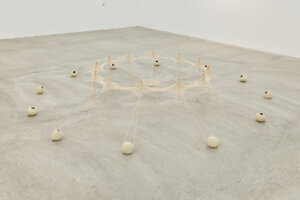
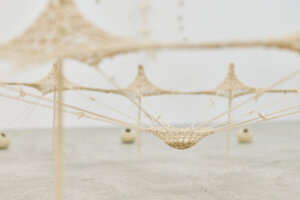
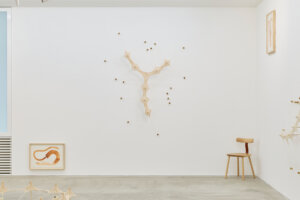
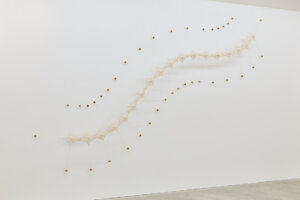
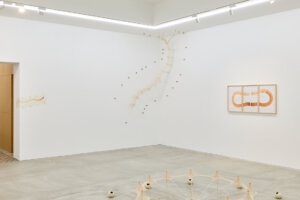
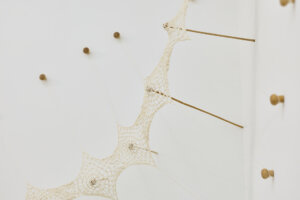
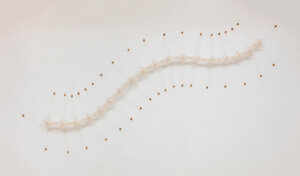
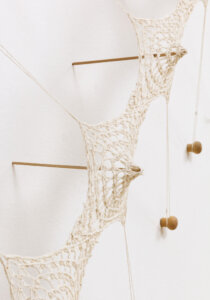
Neto’s new series of works, “SymbioZooEthicalBeings – SZEBs,” presented in the current exhibition, represents an extension of the three-dimensional works and installations that Neto has been creating throughout his nearly 40-year career. Made out of simple materials like crocheted nets and cords made of cotton thread and bamboo, SZEBs are installed in a state of tension, as if pitching a tent against the walls and ceilings, thereby creating delicate drawings within the exhibition space. Resembling writhing, moving animals or insects with numerous legs, they evoke creatures that roam freely through the exhibition space without distinction between front and back. Due to their structure, moreover, air constantly flows through them as if they were breathing. In this sense, SZEBs are a work in perpetual motion, while their forms might be said to have a certain passageway-like quality.
The term “SymbioZooEthicalBeings,” a neologism coined by Neto, is composed of the elements “zooa” (or “zoon”), meaning “animal” in Latin; “symbio,” referring to “symbiosis”; and “ethical,” meaning “ethics.” According to Neto, “we are symbiosis”; indeed, animals and plants, including humans, have continued to evolve to this day through a repeated process of intracellular symbiosis. In other words, all life is the result of symbiosis, and these organic three-dimensional works created by Neto also “exist alongside us within the symbiotic state of this world.” Their clear forms and simple structures, moreover, allude to the irrational, pure world of animals, as if posing the question of whether their world might not be more ethical than human society, which has developed in a complex manner alongside advanced technology.
Clay Drawings Dancing on Paper
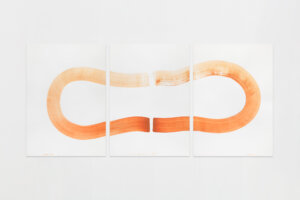
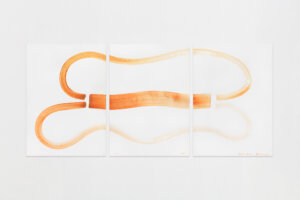
The drawings on display in this exhibition are works from Neto’s “In Search of a Happy Path” series, created in 2024 using clay as the medium. These works came into being as if Neto was breathing, in tandem with the gestures he made while holding the brush. Neto describes them as brushstrokes, traces of action, encounters, time etched into the surface, and dance. The gentle, organic curves in these drawings that echo the forms of Neto’s sculptures and installations might be described as living creatures that have emerged onto the paper. While opportunities to touch clay have become rare in modern urban life, clay represents the very earth itself not only in Brazil, where Neto lives, but also in every other region of the world, including Europe, Africa, the Middle East, and Asia. It has been an essential element, inseparable from human life, since ancient times.
Neto’s artistic practice has always focused on the relationships between various entities, such as materials and existence, in order to express his thoughts on life and the various concepts that govern it. The works on display in this exhibition — the SZEBs and the clay drawings titled “Dreaming Beings” — can be seen as the most straightforward celebration of love for all forms of life and a hymn to Earth, our “home.” Neto goes on to assert that despite differences in region, culture, and language, we who live on this Earth are “all equally living, organic beings who need to eat, sleep, dream, and love every day.” “Dreaming Beings” are exhibited in this space “to reconnect us, and grant us the freedom to dream.” We hope you will take the opportunity to visit this exhibition.
You can find the list of works for this exhibition at the link below.:
Work List
—————————————————————————————–
For press inquiries, please contact: press@tomiokoyamagallery.com
—————————————————————————————–