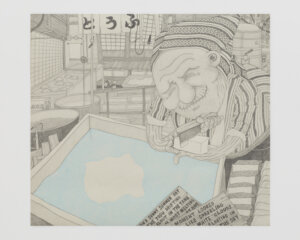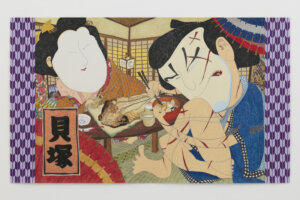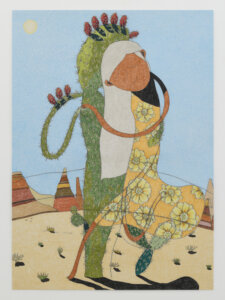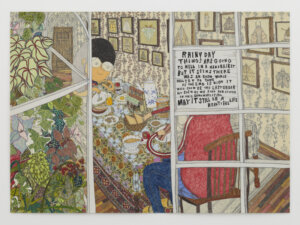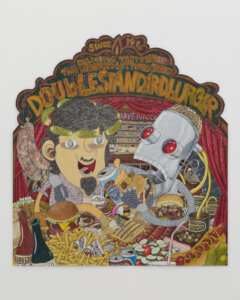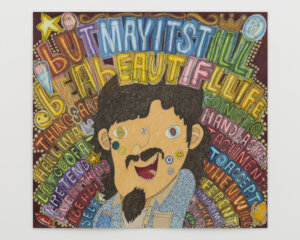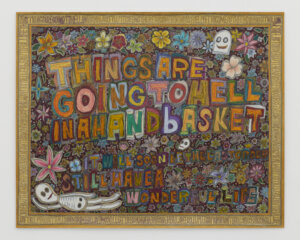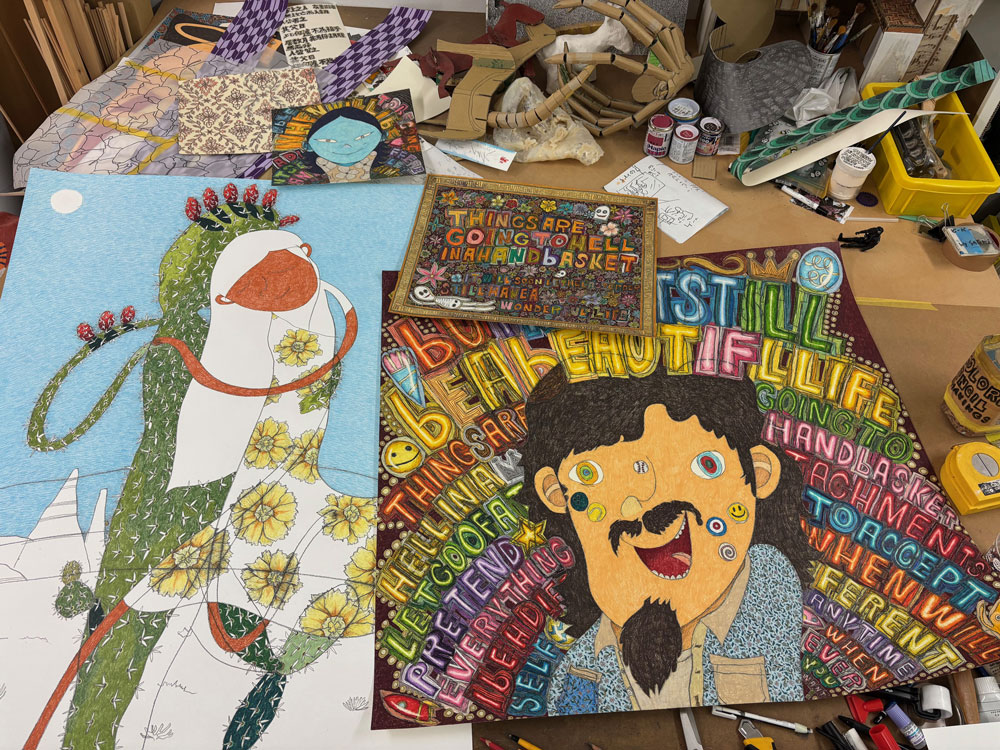
Tomio Koyama Gallery is pleased to present “May It Still Be a Beautiful Life,” a solo exhibition of new works by Shintaro Miyake.
This marks Miyake’s eighth solo exhibition with the gallery since his first in 2003. In this exhibition, Miyake presents a world shaped by his own uniquely heightened self-awareness—one that freely and vividly depicts the world he inhabits, perceives, and has come to know, guided by his keen observational eye and curiosity.
The exhibition will primarily feature works on paper.
【About Shintaro Miyake】
Shintaro Miyake was born in Tokyo in 1970. He graduated in 1996 from Tama Art University, Department of Painting (Printmaking Course), and continues to live and work in Tokyo.
Miyake has developed a richly imaginative and distinctive artistic universe by freely combining a wide range of media and forms of expression, including drawing, painting, sculpture, cut-out works created by drawing on cardboard or wood and cutting along the outlines, as well as live drawing performances in self-made costumes or wearable sculptures, video, and more.
His works—densely composed with fluid lines, vibrant colors, and handwritten text—depict scenes populated by lanky human figures, animals, imaginary creatures, fantastical worlds, food, and architecture. Miyake’s works, with their diversity and playful energy, have captivated audiences around the world. He has held solo exhibitions not only in Japan but also internationally, including in Italy, Austria, Berlin, and Taiwan.
(For a list of major exhibitions, please visit: https://www.tomiokoyamagallery.com/en/artists/shintaro-miyake/#artist-biography)
His works are included in numerous collections, such as the Astrup Fearnley Museum of Modern Art (Norway), Kistefos Museum (Norway), Guggning Museum (Austria), the Rubell Family Collection (USA), and the Takahashi Collection.
【About the Exhibition】
In this exhibition titled, “May It Still Be a Beautiful Life,” Miyake explores the situations and circumstances that we are currently confronted with while addressing fundamental themes such as “life and death” and “self-awareness”
On the occasion of this exhibition, Miyake shares the following statement:
Shintaro Miyake
May It Still Be a Beautiful Life
Every time I see or hear about the many things happening in the world, I find myself thinking more and more that we’ve reached the end of days. This is hardly anything new, as there has always been something or another, ever since I was a child. I don’t remember when I first learned the phrase “Yo-mo-sue (the end of days)*1,” but lately, as I’ve gained the impression that we’ve already reached it, day after day I cannot help but feel as if there’s actually an even further end beyond that.
*1 One of a variety of expressions in Japanese for the phrase “the end of days.”
Rather than describing a literal physical apocalypse, it is often used as a metaphorical or ironic expression to criticize moral decay or the worsening condition of society.
I like the sound of the phrase “Yo-mo-sue,” and I wondered how one might say it in English. It seems there’s an expression: “Things are going to hell in a handbasket.” One explanation traces it back to the French Revolution, when severed heads from the guillotine were carried away in baskets. Another theory states that it comes from a biblical tale in which people were carried to hell in wheelbarrows, later transformed into baskets. Both are frightening, yet somehow strangely compelling.
Speaking of the end of days, how might the world itself come to an end? Is it just because I’ve watched too many films that I imagine humanity being wiped out by AI or robots more advanced than ourselves—like in The Terminator, Westworld or HAL in 2001: A Space Odyssey? I also recall a line I must have learned somewhere, sometime:
“This is the way the world ends / Not with a bang but a whimper.”
Whose words were those again?
I used to think the world would end in some overwhelming terror, but perhaps it will be something far more mundane and subdued. It turns out the line is from T. S. Eliot’s The Hollow Men. Only now do I realize that Dennis Hopper recited it in Apocalypse Now.
With the development of AI, fields that involve thinking and creating are increasingly being taken out of human hands, and at first that frightened me—especially as someone who paints. But somehow, it no longer feels that way. Rather, it feels as though painting has returned to my own hands. I can’t quite explain it, but now that anyone can easily produce images or sculptures, I feel I’ve come back to a place where I can paint for myself again without worrying about others.
I’ve never been particularly good at getting along with the world, so I used my work as a way to connect with it. Yet too much connection can feel constricting. Various thoughts drift vaguely through my mind, but it’s not the good memories that linger—it’s the painful ones that refuse to leave. An old memory, from when I first entered middle school. Even now, it’s something that breaks my heart. I can’t put it into words. So, I painted it. It was a deeply unhappy event, but the painting imagines a world in which that unhappiness never occurred.
Stories of suffering exist in films, in songs, in theater. Madam Butterfly. I had been familiar with Maria Callas’s voice for some time, but only much later did I learn the context of “Un bel dì, vedremo.” Likewise, the song “Otomi-san”—I had heard Hachiro Kasuga sing it on television without understanding the lyrics, and only recently became acquainted with Yowa nasake ukina no yokogushi(The love story of Yosa and Otomi). Having said that, “recently” becomes a slippery term at my age—yesterday and ten years ago don’t feel all that different. I love how Wataru Takada sings, “Whenever you like, anytime at all,” in “Itsu ni nattara (When Will It Ever End?),” and how Florence + the Machine sings, “The dog days are over / The dog days are done.”
The boundary between the worlds I’ve experienced through film and music and the world I’ve lived myself has become increasingly blurred. I sometimes hope that what once frightened me will one day no longer do so, and at other times I feel tearfully that the end is drawing near. Days like these go on for years, for decades.
Just when I think it is already the end of days, an even greater end arrives. Even so, may it still be a beautiful life.
Kenjiro Hosaka (currently Director of the Shiga Museum of Art) wrote the following in Miyake’s monograph I AM HERE (published in 2018):
“(Miyake’s work) is grounded in a sense of crisis about current realities and aims to convey messages. The realities that incited Miyake to create these works provoke complex feelings, but the artist always puts a positive face on things without obviously venting feelings of anger or grief. The work conveys a sense of the possibilities of art today. ”
Miyake’s works emerge from an engagement with the reality that life goes on—joyful at times, difficult at others, yet always continuing. Through his work, we may rediscover the happiness of recognizing such simple truths, things we so often overlook in the course of everyday life.
We invite you to experience Miyake’s latest artistic vision at the exhibition.
You can find the list of works for this exhibition at the link below.:
Work List
—————————————————————————————–
For press inquiries, please contact: press@tomiokoyamagallery.com
—————————————————————————————–